Thursday, June 21, 2012

Church History, part 1

There're a lot of references to the church in our culture, but most people don't get where they come from, so I'm doing some posts on church history. It's going to start with the Apostles and the gospels. I'm going to call the apostles who wrote books of the Bible "saint" because the books are sometimes called the same thing as the author's name and it gets confusing really easily. The gospels are starting out because they give accounts of what happened during Jesus' life, which is important to know about. Also, I'm only going to write about the apostles who wrote books of the Bible right now, but might do the others later. (Polycarp is talked about at the bottom because he's a pretty neat person who was taught by an apostle. He's a really early Christian.)

----

The gospel of Matthew was written pretty recently after Jesus' death, rising, and going up into heaven. It was written from about the year 40. Jesus' crucifixion was about the year 30-34. It's the first of the four gospels and one of the three synoptic gospels. Matthew goes from Jesus' birth to His rising back into heaven. It also is the first book in the New Testament.

When it was written, the Christians were being persecuted in Jerusalem and some left. They had been hearing St. Matthew teach, but since he was in Jerusalem and they weren't, they needed some way of studying the Bible. So, St. Matthew wrote down what he had been teaching and circulated the writings.

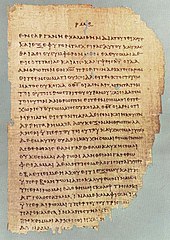
An early manuscript from the Bible. It shows 2 Corinthians 11:33-12:9 and is one of the oldest New Testament papyrus manuscripts.

St. Matthew was one of the twelve apostles. He was a tax collector before following Jesus. Tax collectors were generally disliked because they could take however much money from people as they wanted. They were hired by bidding for an amount of money they'd collect and then would have to collect that money and give it to the government. St. Matthew was probably one of the more educated apostles because he'd have to know math, Arameic, Greek, rhetoric, and had to be comfortable in different cultures. He was born in Galilee and died near Hierapolis or Ethiopia.

The gospel of Mark was written around the year 70. It's the second of the gospels. St. Mark wrote about Jesus' baptism through the Resurrection. Also, on Easter day when the entire account of the crucifixion and Resurrection is read, Mark's account is by far the longest. (And just for a nerdy thing that probably won't ever come in useful, in Mark 14:50-52, that was most likely St. Mark.)

St. Mark is Barnabas' cousin. (Barnabas shows up in Acts during the conflict between St. Mark, Barnabas, and St. Paul over a mission's trip.) When Jesus said that His body and blood were food and drink, lots of the disciples left, and St. Mark went with them. St. Peter talked to him, though, and St. Mark came back. He founded the church in Africa. Some of the liturgy the church there uses goes all the way back to him.

The gospel of Luke is the third gospel. It goes from Jesus' birth all the way to His Resurrection. Some of the parables are only found in Luke (like the one about the good Samaritan). It was probably written after Mark was and from about 75-84 (people say that it was written between 75-100, but St. Luke died near 84, so couldn't have written it after he died). Luke is the gospel with the most literary Greek.

St. Luke was a physician who lived in Antioch in Syria. He wrote Luke and Acts. He was probably an eyewitness of Jesus' life because he uses first person in his writings.

The gospel of John was written around 90 A.D. It begins with John the Baptist affirming Jesus and ends with the Resurrection. The very first verse in John uses a vague word. The English is "In the beginning was the Word, and the Word was with God, and the Word was God." John uses a confusing Greek word, logos, which everybody defines differently. Logos is used in John to describe God.

St. John is the brother of James (they're the sons of Zebedee). He lived longer than any of the other apostles and was the only other one other than Judas Iscariot who wasn't martyred. (Judas Iscariot killed himself after betraying Jesus.) He saw the Transfiguration. St. John taught Polycarp, who was an early martyr.

(Polycarp was arrested, but when the people came to arrest him, he got some food for them and prayed while they ate. He was put into a gladiator ring and the lions didn't attack him. Then, he was burned at the stake and the fire didn't burn him like fire burns people at the stake. It baked him like bread. Then he was stabbed. To Roman Catholic, Oriental Orthodox, Eastern Orthodox, Lutheran, and Anglican churches he's a saint, too.)

Thursday, May 10, 2012

WWII Tank comparisons

Greetings everyone!

It's been a while since "Kate" or I have posted anything, and I feel that you may wish to have the pleasure of reading another post. :D

I've been doing quite a bit of reading, lately, and could certainly pontificate about Montgomery or Rommel quite a bit.

In fact, it now seems to me that Rommel wasn't as great a general as he is typically chalked up to be by historians. They herald him as "The greatest general Germany has ever seen." Well, that would only be partly true, because he wasn't really a great all around general. Oh, don't get me wrong, he appreciated the might of great, concentrated Panzer rushes, but he had very little concept of logistics, allied cohesion, staff work etc. In fact, if it weren't for British ineptitude, Auchinleck, Ritchie, Wavell etc. all had the opportunity to destroy the Africa Korps far before Montgomery after the Second Battle of El Alamein from the 23rd October to the 4th of November, 1942. When matched by a man who understood proper cohesion of armour and infantry, Rommel was sent reeling - and was never again granted the initiative that he so desired (and that Auchinleck and the others granted him).

 But anyway, I've selected instead to write about the comparisons of Western armour in WWII. We shall see how badly the Allies were outgunned throughout the latter years of the war by Germany. I will do it in segments, considering the number of tanks used.

Early War:

In 1939 and 1940, the British boasted the following tanks:

Matilda I, armed only with a machine gun and having a top speed of 12.9 km, saw action in France in 1940. The Matilda II, its successor, was armed only with a 2 pounder cannon and a Besa machine gun. However, its armour was up to 78 mm thick, which meant it could withstand fire from most early German tanks and even antitank guns. The Matilda II could also reach a top speed of 24 km/h.

The Light Tank Mk VI "Vickers" was the most plentiful for the British right into North Africa. "Seven Royal Armoured Corps divisional cavalry regiments, the principal armoured formations of the BEF, were each equipped with twenty-eight Mk VIs.The 1st Armoured Division, elements of which landed in France in April, was equipped with 257 tanks, of which a large number were Mk VIB and Mk VICs. The 3rd Royal Tank Regiment, which formed part of the division's 3rd Armoured Brigade, possessed by this time twenty-one Mark VI light tanks" (Wikipedia). The Vickers tank boasted only a heavy Vickers machine gun and a Besa machine gun, though its armour was up to 15 mm thick.

French tanks were typically excellent, but they were widely dispersed, poorly utilized and poorly operated. French tank doctrine suggested that they operate only in support of infantry.

Renault FT-17, was a World War I vintage tank with a 37 mm cannon or a machine gun. Its variants boasted up to 22 mm of armour. It had a top speed of about 8 km/h.

Renault R-35 had a 37 mm L/21 cannon and a 7.5 mm machine gun. It was heavily armoured with 45.7 mm of frontal armour, and it had a top speed of about 20 km/h.

The AMR 35 (Automitrailleuse de Reconnaissance Renault Modèle 35) was a light tank, developed by Renault as a support vehicle for mechanized infantry.

The Hotchkiss 35 and its variants (H-38 and H-39) was a nice tank with a 38 mm, longer cannon that was more capable of puncturing German armour. It had 45 mm armour and a top speed of 36.5 km/h on roads.

The Somua S-35 was undoubtedly France's best tank, and one of the best in the world at the time. It had such heavy armour and good armament to be comparable to even the Pz Kpfw IV, but it had only a one man turret, which was a grave defect and handicapped it effectively. Its armour was up to 55.8 mm wide! It's cannon was a 47 mm SA35 (more than 3lb shell).

And then the Char B-1, which armour was so thick (60 mm frontal armour), that it could never be penetrated by German anti-tank guns (which were only about 37 mm). The Germans could only reliably pierce it with the 8.8 cm anti-aircraft gun. 400 were available to the Army in 1940, but they were not concentrated. The Char B-1 had two cannons and two machine guns (one coaxial and one mounted). The turret cannon was a 47 mm cannon; the second cannon, mounted in the hull, was 75 mm large.

Char variants D1, D2 (Medium tanks) and 2C (another heavy tank) saw action, as well.

Poland had only three reliable tanks: the TK3 tankette, the Renault 35 and the 7TP. 135 7TPs were available in the Polish forces in 1939; while they could easily match German tanks, there simply were not enough of them. There were actually "two variants: a twin turret version and a single turret version. The twin turret version was armed with two 7.92 mm Ckm wz. 30 machine guns The two turrets were not fully traversable, and were therefore not very effective. The single turret version was armed with a modified Bofors 37 mm anti-tank gun 36 (named 37 mm Bofors wz. 37) with a Zeiss telescopic sight and a single Ckm wz. 30 machine gun.

Axis:

Germany:

Pz. Kpfw. I: The "Panzer I" was armed only with dual machine guns and had only 5 mm of armour. Compared against most of the Allied tanks of even 1939, this one was vastly inferior. It reached a maximum speed of 37 km/h.

Pz Kpfw II: This light tank "...was the workhorse of the German tank corps during the early years of World War II. Being equipped only with a 20 mm automatic cannon, Germany relied on quantity during their early campaigns. With more than 1000 Pz Kpfw IIs employed in both the Poland, France and North Africa, the Pz Kpfw II was fundamental in the early victories" (Tanks in WWII). Its armour may have gotten up to 30 mm on select tanks. It had a top speed of 40 km/h on roads.

Neubaufahrzeug: Only three were used in Norway. This thing was a heavy tank with dual turrets. The turret cannon was a 75 mm KwK L/24, and the other a 37 mm KwK L/45. It also boasted two machine guns and up to 20 mm of armour. It could reach a speed of 25 km/h.

Pz. Kpfw. 35(t) Skoda was built by Czech factories. If the Czechs had have fought the Germans in 1938, this tank could have crushed German armour. It saw action as late in the war as 1942. It mounted a 37 mm cannon and had up to 25 mm in armour (as well as two machine guns). It was an incredibly reliable tank.

Pz. Kpfw. 38 (t) Praga TNHP-S LT 38: Also a Czech tank, designed by CKD, the Panzer 38(t) was superior to Germany's own tanks of the time. It packed a 38 mm cannon, two machine guns and 25 mm of armour (later up to 50.8 mm).

The Pz Kpfw III started with a 37 mm Kw K (L/45), but eventually upgraded to as much as a 75 mm (though most common throughout 1941 and 1942 was the 50 mm cannon). It's armour ranged from 5–70 mm throughout the war. Its max speed on the road was 40 km/h.

Italian Tanks:

~~ to complete later.

Friday, February 18, 2011

Martin Luther


(Today's his death day, actually.)

The guy in the picture is Martin Luther, not to be confused with Martin Luther King or Martin Luther King, Jr. Those two were named after him.

Martin Luther was going to be a lawyer, but quit college to become a Catholic monk. He then decided that the Pope wasn't interpreting the Scriptures correctly. He was sent to Rome to deliver some letters, and was
absolutely appalled at the practice of Indulgences.

An Indulgence is the full or partial pardon of sins, which occurs when gazing on relics, paying for pieces of paper, saying the Lord's Prayer while climbing some steps, and a lot of other acts like that. Luther said that by doing those, you are depending on yourself and not on Jesus Christ to save you. He wrote 95 Thesis and hung them up on the Wittenburg Castle Church on October 31st, 1517.

He was called up before the Emperor for that, and asked to recant. Luther was prepared to give an answer, and so was allowed to come back at noon the next day. That was when he gave probably his most famous speech.

"Unless I am convinced by the testimony of the Scriptures or by clear reason (for I do not trust either in the Pope or in councils alone, since it is well known that they have often erred and contradicted themselves), I am bound by the Scriptures I have quoted and my conscience is captive to the Word of God. I cannot and will not recant anything, since it is neither safe nor right to go against conscience. May God help me. Amen."

The Catholic church declared him a heretic. That meant that he would be arrested and killed, like many other theologians for centuries. Luther was given safe passage back to Wittenburg, but Prince Fredrick didn't trust that.

Prince Fredrick kidnapped Luther (without the afor-mentioned lawyer-turned monk-turned outlaw) knowing. He stayed in an attic in the Wartburg Castle. While there, he translated the New Testament from Koine Greek into German so that plain old people could read it. He also wrote about a gazillion theological writings.

When Luther returned secretly to Wittenburg, he wrote in a letter, "During my absence, Satan has entered my sheepfold, and committed ravages which I cannot repair by writing, but only by my personal presence and [the] Living Word [of the Bible]." For eight weeks in Lent, he preached a sermon every Sunday that affirmed that what the Bible says is true.

Even though helping in Wittenburg had worked, people outside of that town were taking his writings and teachings too far. They were actually planning to attack the Roman Catholic church. Luther managed to keep them from doing it, but pointing out that we should love our enemies, and not hurt them.

Luther actually married a nun. Katharina von Bora and eleven others escaped from a nunnery in herring barrels. They moved into a former monestary, which was a gift from John the Steadfast. The two had six children, and were very poor. A few of the children died during their childhood.

He also wrote two catechisms, established a new church denomination, and made a new order of service (now called the Divine Service). The service was conducted in German so that everybody could participate. Luther wrote several hymns, and translated the Bible from Greek and Latin into German.

At the end of his life, he was extremely sick. Luther went to settle a dispute, and apparently died on the way home. Maybe the dispute was too noisy and it was just too much for him. He was buried in the same church he had been hidden in.

Wednesday, January 26, 2011

Why Field Marshal Law Montgomery was much greater than Patton.

Greetings all, and my sincerest apologies about the length between posts. I simply haven't had the time to maintain this blog, but here I am, at last! :D

I'm going to initiate my return with a very controversial topic - many believe that George S. Patton was the greatest American tank commander, and even general, of all time. These individuals also tend to frown on the caution displayed by his English counterpart, rival and superior, General Montgomery.

Here are some basic points I am going to offer:

1. Patton was a contemptible man who instigated strife among his fellow commanders and the Allied High Command.

2. Patton didn't seem to believe in a "grand alliance." Or, if he did, he attempted to belittle International efforts. He hated the English, detested the Arabs, scorned the Russians, beleaguered the French etc.

3. Patton was disloyal to his wife... It almost seems that he dated his niece, Jean Gordon. She certainly became too close to him.

4. Patton was a reckless general, and he seemed to hold the belief that the war was designed for his further gains and glory (charge around Messina and the Waters' incident come to mind)

5. Patton was a vulgar man who luxuriated while seeming to ignore the needs of his soldiers (slapping several men who suffered from battle exhaustion, preferring petrol over food rations, drawing a revolver in a hospital etc.)

6. Patton, "Talked too much." He couldn't keep secrets and thence was not privy to certain information or developments in Allied High Command (Eisenhower never informed him about Ultra, and he was not privy to much of the planning regarding Overlord).

7. Patton was too impetuous to be a great soldier, and he directly disobeyed orders from his superiors.

That's all for the moment. I'll let you readers consider that and wait anxiously for the next part. ; )

Friday, December 17, 2010

Medieval England

Since Agent hasn't posted yet, and there hasn't been a new post for eight months, here's one! It's actually a link to something interesting that ya'll probably didn't know.

Go here for it.

Wednesday, May 5, 2010

Karl Marx

Karl Heinrich Marx lived from May 5, 1818 to March 14, 1883. He was a philosopher, political economist, sociologist, political theorist, revolutionary, and a humanist. Mr. Marx is often known as the father of communism. He was a political activist. He also analysed history.

He wrote in The Communist Manifesto,

"The development of Modern Industry, therefore, cuts from under its feet the very foundation on which the bourgeoisie produces and appropriates products. What the bourgeoisie therefore produces, above all, are its own grave-diggers. Its fall and the victory of the proletariat are equally inevitable."

Not many people knew about Mr. Marx during his lifetime. Soon after he died, all the ideas he had gave a real influence on workers' movements. His influence was given extra force when the Marxist Bolsheviks had victory in the Russian October Revolution. Few parts of the world weren't touched by Marxain ideas during the 1800's.

He was the third child out of seven children. Karl Marx’s family was Jewish. They lived in Trier, which is in the Kingdom of Prussia’s Province of the Lower Rhine.

Karl Marx’s father (Heinrich, 1777 through 1838) was in a long line of rabbis, and then converted to Christianity—even though he tended to be a diest. The older Mr. Marx also admired Englightenment people, like Rousseau and Voltaire. He was actually born Hershel Mordechai. When the Prussian athorities banned him from practicing law as a Jew, he joined the Lutheran denomination. The official denomination of the Prussian state was actually Lutheren.

Karl Marxs mother was Henrietta (1788 through 1863). Sophie, Hermann, Henriette, Louise, Emilie, and Caroline

He was a homeschooler until he was thirteen. He graduated from the Trier Gymnasium and enrolled in the University of Bonn (1835). Karl Marx was seventeen when he began studying law. He joined the Trier Tavern Club, a drinking society and served as its president for a while. Mr. Marx’s grades dropped during his time in the Club. He was really interested in literature and phylosiphy, but his father disaproved of it. The older Mr. Marx thought that his son couldn’t support himself highly enough.

After Mr. Marx began law school, his father made him go to a far more school-enclined and serious Friedrich-Wihelms universitat in Berlin. While there, Mr. Marx wrote a lot of poems and essays about life. He used the theological language that he had picked up from his deistic, liberal father (like “the Deity,”) but also used atheistic philosophies of the Young Hegelians—who were very active in Berlin at the time.

In 1841, he wrote a thesis called The Difference Between the Democritean and Epicurean Philosphy of Nature and earned a doctorate. He had to submit it to the University of Jena. Mr. Marx was warned that because he was a Young Hegelain radical and was known as one amoung the faculty, the thesis would have a bad reception in Berlin.

When Europe began to have a lot of revolutions, Mr. Marx was arrested and banned from Belgium. A radical movement had taken power from King Louis-Philipe in France. They asked Mr. Marx to go back to Paris.

Mr. Marx witnessed the June Days uprising first hand.

When the uprising collapsed in 1849, he went back to Cologne. Mr. Marx started the Neue Rheinische Zeitung.

While the newspaper was still around, Mr. Marx was put on trial twice because of a press misdemeanor. Then, he was charged with a suggestion of an armed rebellion. He was aquitted both times. Eventually, the paper was suppressed.

Mr. Marx went back to Paris, but had to move to London. in May 1849.

He stayed there for the rest of his life.


Wednesday, March 31, 2010

Canada's Dismal State Leading to World War II

World War II ignited spontaneously. A very short arms race was engaged in slightly before Poland was invaded, but the only nations actually ready for a conflict of scale were Germany, Italy and Japan. Even the mighty Imperial Great Britain was caught off guard and with a poorly equipped Air Force, slightly obsolescant technology on its Naval Fleet and an expeditionaty force that likely wasn't ready for such a conflict (such as the latest asdic on its battleships). (This said, if the French had been able to stand, the English Expeditionary Army, almost 200,000 strong) was strong enough to halt the German Blitzkireg in its tracks, if circumstances had been slightly different...)However, unlike the mighty UK, France, Netherlands, China, Poland, Norway, Denmark, USA, USSR and Canada were all caught entirely off guard and with little power of significance, initially.

Canada, throughout the war, fought in various compaigns, including even establishing its own Beachhead at D-Day, campaigning through Normandy and the Scheldt, Holland, Belgium, Italy, escorting and providing the entire brunt of anti U-boat war in the West-Atlantic for many years and aiding and supplementing fighting in the Pacific and in the bombing campaigns. It may be of great dismay that even though Canada fought so bravely, it spent its first years mobilising, such was its disrepair.

The Royal Canadian Navy was in a very pitiful state at the start of the war - it relied on a top heavy Corvette fleet. Before these Corvettes could be utilized in the heavy Atlantic Squalls, they had to be modified en masse so that they wouldn't pitch excessively and threaten to topple over, because they were top heavy. Yet, the Canadian Government ordered eighty-some of these ships throughout the course of the war. If you analyze this source: http://en.wikipedia.org/wiki/Flower_class_corvette#Royal_Canadian_Navy, you will see that only five of these Flower Class Corvettes were Commissioned by 1940. In essence, Canada's Navy was dependant upon six destroyers, all of which were River Class, five Flower Class Corvettes and a handful of minesweepers and a few other small ships (including dependancy on armed yachts). As of 1939, the RCN consisted of only 191 officers and 1,799 ratings.Furthermore, the asdic and radar utilized by the Navy was severely obsolete until 1944, during which Canada was finally able to equip most of its fleet with the top of the line English asdic. The Hedgehog and Squid equipment were introduced into the Canadian Navy long after the English had adapted it. Now considering that the Canadian Royal Navy was being depended upon to provide escort for every convoy in the West Atlantic, including down to the Bahamas, after the United States joined the war and sent most of its operational fleet to the Pacific, this is a sad revelation.

The Royal Canadian Air force was in equal terms of grim repair. "In a grim report to the incoming Liberal Government, McNaughton warned that Canada had not a single anti-aircraft gun... Canada had only 25 obsolete operational aircraft, and not a single bomb." * (Military history of Canada)"September 1, 1939, the RCAF had a total strength of 4,000 personnel (400 officers and 3,600 airmen) of whom three-quarters were in the Regular component and the remainder in the Auxiliary. There were eight Regular squadrons comprised of two general purpose, two general reconnaissance, one fighter, one bomber, one torpedo- bomber, and one army co-operation. The Auxiliary Force consisted of 12 squadrons including four fighter, four bomber, two army co-operation, and two coast artillery co-operation."The RCAF had a total of 270 Aircraft of 20 assorted types. In the last days of August, when the situation in Europe was becoming extremely critical, the Regular squadrons began moving to their "war stations." When, on September 1, 1939, Hitler invaded Poland, Canada placed her armed forces on active service. Nine days later Canada declared war on Germany." ** (Airforce)In contrast, the French Air force contained the excellent Morane-Saulnier MS-406, the Bloch MB 170 bomber and the Dewoitine D.520 fighter plane."...only nineteen (19) Hurricanes and and ten (10) Fairey Battle light bombers could be considered front line aircraft." *** ( The Air Force 2) After the Battle of Britain, the Fairey Battle was considered obsolescant, once called "a monster that lumbers - it doesn't fly". (Suddenly a Spy)

The Army, to touch briefly on it, was also in atrocious condition. When it began mobilizing in the late 1930s, it was quite clear that the Depression had taken its toll. The Officers were trained in Canada Military College before being sent to learn of strategy in England, but this training proved to often be inadequate when regarding artillery, armoured and infantry coordination.Many of the soldiers dug out old World War I relics for uniform and weaponry; Lewis guns, Ross Rifles, Lee-Enfield No. 1 and other World War 1 relics were much evident in the original militia formations.Canada mobilized the Canadian Active Service Force, a corps of a mere two divisions."The Permanent Active Militia (or Permanent Force (PF), Canada's full time army) had just 4,261 officers and men, while the Non-Permanent Active Militia (Canada's reserve force) numbered 51,000 partially trained and ill-equipped soldiers. Modern equipment was scarce all around. Attempts to modernize had begun in 1936 but equipment procurement was slow and the government was unwilling to expend money to equip the new tank battalions introduced that year." ***** (Mobilization of Armed Forces)Modern weaponry, such as the Bren Gun, were slow in coming; in fact, the Bren Gun scandal made Mackenzie and Parliament considerably reluctant to arm its army with modern weapons. Its armoured Divisions were initially few and poorly equipped until 1940-41, after which it was manufacturing some excellent vehicles, such as the Ram Tank, which was never used as the useless Sherman was utilized in most Allies Divisions.

Why was Canada so unprepared in the first place? It largely disarmed during the Depression, due to financial difficulties. It only had a handful of regular (active) Regiments, which still possessed aged weapons. Budget cuts nearly crippled the RCAF, which possessed a smattering of obsolescent biplanes and even less of the Hurricane Mk. 1, Fairey Battles or Bristol Blenheim bombers.

As aforementioned, the Canadian Navy was limited to six River Class destroyers (two arrived in 1939 and 1940), a handful of top heavy Flower Class Corvettes (The Flower Class Corvette was an inadequate ship for the Atlantic. It rolled and pitched so often that everything got wet. Crew morale was often extremely low, as even rations were 'salty and soggy'. Furthermore, there were so few of these Corvettes that only one or two could be in port for relief at any one time - the rest had to be perpetually active in ever-harrowing convoys.) It was so desperate that it employed Armed Yachts - what purpose does an Armed Yacht serve, may I ask?

And while the Navy was scrambling during the war, the German U-boaters were jubilant with two 'Happy Times' in the Atlantic, in which hundreds of thousands of tonnes were lost each time. The U-boats preyed right up to the Coast of the US and Canada, and even into the Gulf of Mexico, St. Lawrence and the Bay of Fundy. It was the Royal Canadian Navy that was responsible for much of the convoy duty in the Eastern Atlantic, as the USA, when it joined the war, sent most of its fleet to the Pacific. So that's a second reflection on the state of Canadian Armed Forces.

Next, let me share a couple of Anecdotes and a few other follies. The Canadian Government wished for the Canadian Army to stay together - all five divisions. It refused to let them be implemented into any fighting until Italy, when it finally conceded upon pressures from Crerar and restless soldiers that had been training in England for two whole years. Well this was, indeed, a mistake, as proven later on. When the Canadian Armies hit Sicily, Italy and Normandy, their communications and tank/artillery/infantry cooperation were extremely poor. The training they received meant very little in the face of real fire; so why didn't the Canadian government allow a division at a time to gain experience in Africa? It became evident that the English 8th was far better than Rommel's Afrikaan Korps and was driving it backwards while the US and English landed armies in Tripoli and Tunisia. Why didn't the Canadian Government allow some of its divisions to gain valuable battle experience in an already determined victory?

Rather, they shocked them by plunging them straight into battle - facing fire - at drops on Sicily and into Italy, and for the rest of it, at Juno Beach. this was terrible for Canadian morale and poorly thought of by the command structure. It became evident that NCO's, regimental and even Divisional commanders were mostly inadequate. Wholescale sackings had to take place, but Canadian officers did not distinguish themselves, except for Guy Simonds and Crerar (who also narrowly escaped being sacked on one occasion). In fact, the Canadian Army was trained largely at Battalion and Regimental level. The loyalties were fierce, but when other companies were tacked on, or they had to fight as a Division, they often floundered as they weren't so fiercely loyal to their Division, and may even have dissented other Regiments of the Division, in some cases.

Another point is that throughout the war, Canada was always a step or two behind its Allies in innovation. Its planes were always inferior, its ships were always lacking the latest asdic or radar, its military the latest wireless sets or mortars. For example, the HAndley Page Halifax was kept in the RCAF as a heavy bomber until 1945! The Halifax was described as a 'metallic tinderbox' due to the placement of its engines. It was slow and it could not pull a looping dive or it would spin out of control and all hands would be lost. Of course, Canada was given the lowest priority for the greater planes (such as Liberators, Flying Fortresses, or greater Lancasters) and technologies, though it was one of the 'Big Four'. It never received the Gloster Meteor, the P51 Mustang or other great planes (it did acquire a substantial amount of Spitfires, but few of them were Mk VI's)

In fact, even though the Royal Canadian Navy was responsible for most Atlantic Convoys in '41, '42, '43 and '44, the United States exercised some command over it from a Naval base on Canadian territory! Outrageous!!! the USA hadn't a consistent ship in the area, yet it's exercising convoy command. A tremendous folly of the Canadian government.

Another Folly of the Atlantic was the mid-Ocean gap. Throughout 1941, '42 and '43, much of the mid-Atlantic wasn't covered by planes or dive bombers, which would keep U-boats submerged and incapable of grouping into 'wolf packs'. It (and England) did not utilize planes and Carriers to close this gap from their respective shores until late 1943 and 1944.A last folly that I shall discuss was the Canadian Government's sheer stupidity in the following anecdote. Leading into the Battle of Ortona, the English soldiers had been fighting at the base of Italy for sometime and were worn out. Mackenzie agreed that the 1st Canadian Division could substitute for the English, so the English gradually began to withdraw. However, for 'easier shipping purposes', it was agreed by BOTH parties that the Canadians would leave their equipment in England and the English would leave theirs in Italy. It apparently did not occur that the Canadians would then be utilizing worn out, sometimes broken and often grungy equipment that had seen much battle in lieu of its (Canadian) brand new equipment that had been left behind in England!!! eventually the First Canadian Division received some of its equipment, but it took three weeks to make the Division operational in Italy.

And, as I've mentioned, the Canadians had an excellent medium tank - the Ram Tank. The Ram Tank was better in quality than the Sherman (larger gun, thicker armour, stronger engine, wouldn't 'brew up' with a shot from a Tiger at 1,000 yards), yet the Army abandoned its Rams because England insisted that all forced standardize with the Sherman. Is that not stupidity in the entire essence? The Sherman 'brewed up' as easily one could imagine; yet because the USA could produce them faster than they were lost, they were the 'ideal tank'. Bah Also, the Ram could actually penetrate the Panzer's Armour at 200 yards, whereas the Sherman could be 150 yards away and there was no guarantee that the shell wouldn't just bounce off and into the sky.

Wednesday, February 3, 2010

Operation Marketplace

(Also called Operation Market Garden)


(Parachuters landing in the Netherlands on September 17, 1944.)


Operation Marketplace was created to free the Netherlands from the Germans.

The operation started on September 17, 1944. It was the largest Allied airborne operation ever.

In the 82nd Airborne Division, 89% of troops landed on or within 3,300 feet of their drop zones and 84% of gliders landed on or within 3,300 feet of their landing zones. This contrasted with previous operations where night drops had resulted in units being scattered by up to 12 miles.

Apparently, German flack was heavy but didn't do much damage. They must not've been good shots.

Capturing the bridges were so important that if the Allies didn't capture them, Operation Marketplace would fail.

The radios that were used for communication were having a bit of trouble at that point. Because of the mis-communication, the 508th Parachute Infantry Regiment started taking the 2,000 feet long Nijmegen highway bridge late in the day. They were supposed to start as soon as possible.

The Germans got wind of what was happening rapidly.

Field Marshal Walter Model was staying at the Tafelberg Hotel in a village to the west of Arnhem (Oosterbeek). At first, he was confused about what the British were doing landing in "his" country side. He decided they were trying to kidnap him, and ran for somewhere safer.

Wilhem Bittrich (commander of the 2nd Panzer Corps) had a less-muddled head and sent a reconnaissance company (made of the 9th SS Panzer Division) to Nijmegen to make the bridge defenses stronger.

At 12:00 at night, Commander Model had figured out the situation and given orders for the defence of Arnhem. The normal confusion with airborne operation was not present at Arnhem. The advantage of surprise wasn't too much of an advantage.

On the 18th of September, fog covered everything.

All air operations were cancelled on the 22nd and 24th of September.

September 19

The 1st and 3rd Parachute Battalions pushed towards the Arnhem bridge during the early hours of September 18 and made good progress but they were frequently halted in skirmishes as soon as it became light. With their long and unwieldy columns having to halt to beat off attacks whilst the troops in front carried on unaware, the Germans delayed segments of the two battalions, fragmented them and mopped up the remnants.

Early in the day the 9th SS Reconnaissance Battalion (sent south the day before) concluded it was not needed in Nijmegen and returned to Arnhem. Though aware of the British troops at the bridge, it attempted to cross by force and was beaten back with heavy losses, including its commanding officer, SS-Hauptsturmführer Gräbner.
By the end of the day the 1st and 3rd Parachute Battalions had entered Arnhem and were within 1 mile of the bridge with approximately 200 men, one-sixth their original strength. Most of the officers and non-commissioned officers had been killed, wounded or captured. The Second Lift was delayed by fog and jumped onto a landing zone under heavy attack but landed at full strength (the 4th Parachute Brigade consisting of the 10th, 11th and 156th Battalions of the Parachute Regiment, commanded by Brigadier-General John Winthrop Hackett) and C and D Companies of the 2nd South Staffordshire Regiment.

Grave proved to be well defended and German forces continued to press on the 82nd deployed on the Groesbeek heights to the east of Nijmegen. The 505th Parachute Infantry Regiment defended against German attacks in Horst, Grafwegen and Riethorst. Early in the day, German counterattacks seized one of the Allied landing zones where the Second Lift was scheduled to arrive at 13:00. The 508th Parachute Infantry Regiment attacked at 13:10 and cleared the LZ by 14:00, capturing 16 German flak pieces and 149 prisoners. Delayed by weather in Britain, the Second Lift did not arrive until 15:30. This lift brought in elements of the 319th and 320th Glider Field Artillery battalions, the 456th Parachute Field Artillery battalion and medical support elements. Twenty minutes later, 135 B-24 bombers dropped supplies from low level (100'), 80% of which was recovered.

Faced with the loss of the bridge at Zon, the 101st unsuccessfully attempted to capture a similar bridge a few kilometers away at Best but found the approach blocked. Other units continued moving to the south and eventually reached the northern end of Eindhoven.

At 06:00 hours the Irish Guards Group resumed the advance while facing determined resistance from German infantry and tanks.101st Airborne were met by the lead reconnaissance units from XXX Corps. At 16:00 radio contact alerted the main force that the Zon bridge had been destroyed and requested that a bailey bridge be brought forward.

By nightfall the Guards Armoured Division had established itself in the Eindhoven area[101] however transport columns were jammed in the packed streets of the town and were subjected to German aerial bombardment during the night. XXX Corps engineers, supported by German prisoners of war, constructed a class 40 bailey bridge within 10 hours across the Wilhelmina Canal.

During the day the British VIII and XII Corps, supporting the main attack, had forged bridgeheads across Meuse-Escaut Canal while facing stiff German resistance; 50th (Northumbrian) Infantry Division was transferred from XXX Corps to VIII Corps so to relieve XXX Corps from having to secure the ground gained thus far. Throughout the day German attacks were launched against XXX Corps and against the newly gained bridgeheads over the Meuse-Escaut Canal, all without success.

During the early morning hours the 1st Parachute Brigade began its attack towards Arnhem Bridge, with the 1st Battalion leading supported by remnants of the 3rd Battalion, with the 2nd South Staffordshires on the 1st Battalion's left flank and the 11th Battalion following. As soon as it became light the 1st Battalion was spotted and halted by fire from the main German defensive line. Trapped in open ground and under heavy fire from three sides, the 1st Battalion disintegrated and what remained of the 3rd Battalion fell back. The 2nd South Staffordshires were similarly cut off and save for about 150 men overcome by midday. The 11th Battalion, (which had stayed out of much of the fighting) was then overwhelmed in exposed positions while attempting to capture high ground to the north. With no hope of breaking through, the 500 remaining men of these four battalions withdrew westwards in the direction of the main force, 5 km (3 miles) away in Oosterbeek.
The 2nd Battalion and attached units (approximately 600 men) were still in control of the northern approach ramp to the Arnhem bridge. The Germans recognised that they would not be moved by infantry attacks such as those that had been bloodily repulsed on the previous day so instead they heavily shelled the short British perimeter with mortars, artillery and tanks; systematically demolishing each house to enable their infantry to exploit gaps and dislodge the defenders. Although in battle against enormous odds, the British clung to their positions and much of the perimeter was held.

To the north of Oosterbeek the 4th Parachute Brigade led an attempt by the 1st Airborne Division to break through the German lines but communication difficulties and enemy resistance caused the attack to fail with heavy losses. The Division, scattered far and wide and hard pressed by the enemy on all sides had lost its offensive capability. Unable to help Lt.-Col. Frost at the bridge, the remaining soldiers attempted to withdraw into a defensive pocket at Oosterbeek and hold a bridgehead on the north bank of the Rhine.
The parachute elements of the Polish 1st Independent Parachute Brigade had remained in England because of dense fog. Their gliders, mainly carrying anti-tank guns and vehicles, were able to take off but had the misfortune to arrive above the landing zone just as the 4th Parachute Brigade was retreating across it and the gliders came under fire from German units pursuing the Brigade.

At 08:20, the 504th Parachute Infantry Regiment made contact with the Grenadier Guards of the XXX Corps at Grave. This enabled the Regiment to move on to other missions and place the 3rd Battalion in division reserve. By this time, according to the plan, they were due in Arnhem. XXX Corps were eight miles from Arnhem with six hours in hand, 'The earlier delays had been made up' (Neillands). A combined effort to take the Nijmegen bridge was mounted by two companies from the Guards Armoured Division and the 2nd Battalion, 505th Parachute Infantry Regiment. The attack got within 400 meters (400 yards) of the bridge before being stopped; skirmishing continued throughout the night. A plan was made to attack the south end of the bridge again while the 3rd Battalion, 504th Parachute Infantry Regiment, planned to cross the river in boats 2 km (1 mile) downstream and then attack the north end. The boats, requested for late afternoon didn't arrive. Once again XXX Corps was held up in front of a bridge which should have been captured before they arrived.
The 1st and 5th battalions, Coldstream Guards, were attached to the division. A supply attempt by 35 C-47s (out of 60 sent) was unsuccessful; the supplies were dropped from a high altitude and could not be recovered. Bad weather over English bases prevented the scheduled big glider mission carrying the 325th Gilder Infantry Regiment from taking off, ending any hope for the scheduled reinforcements for the 82nd Airborne.

At 09:50 the 504th Parachute Infantry Regiment was going forward to Wijchen, to attack the Edithbridge from its south end. The bridge was secured. After this fierce engagement they pushed on to the traffic bridge south of Wijchen. Another fierce engagement followed and this bridge was secured.

To their south, units of the 101st sent to take Best the day before were forced to yield to German counterattacks during the morning. British tanks arriving during the day helped push back the Germans by late afternoon. Later a small force of Panther tanks arrived at Zon and started firing on the Bailey bridge. These too were beaten back by anti-tank guns that had recently landed and the bridge was secured.

September 20

Lt. Colonel John Frost's force at the bridge continued to hold and established communication via the public telephone system with 1st Division around noon learning that the division had no hope of relieving them and that XXX Corps was stopped to the south in front of Nijmegen bridge. By the afternoon the British positions around the north end of Arnhem bridge had weakened considerably. Casualties, mostly wounded, were high from constant shelling. An acute lack of ammunition especially anti-tank munitions, enabled enemy armour to demolish British positions from point-blank range. Food, water and medical supplies were scarce, and so many buildings were on fire and in such serious danger of collapse that a two-hour truce was arranged to evacuate the wounded (including Lieutenant-Colonel Frost) into German captivity. Frederick Gough took over as commander when Frost left.

The Germans overcame pockets of resistance throughout the day, gaining control of the northern bridge approaches and permitting reinforcements to cross the span and reinforce units further south near Nijmegen. The remaining British troops continued to fight on, some with just fighting knives but by early Thursday morning almost all had been taken prisoner. The last radio message broadcast from the bridge - "Out of ammo, God save the King" - was heard only by German radio intercept operators.
While it was estimated that the 1st Airborne Division, 10,000 strong, would only need to hold the Arnhem bridge for two days, 740 had held it for twice as long against far heavier opposition than anticipated. While 81 British soldiers died defending Arnhem bridge, German losses cannot be stated with any accuracy, though they were high; 11 units known to have participated in the fighting reported 50% casualties after the battle. In memory of the fighting there, the bridge has been renamed the "John Frost Bridge".

Further west the remnants of the 1st Airborne Division were gathering at Oosterbeek for their last stand; those already there were not seriously challenged by the enemy throughout the day. To the east of the village the 1st, 3rd and 11th Parachute Battalions and 2nd South Staffordshires were organised into a defensive position and in desperate fighting later in the day they bloodily repulsed an enemy attack which threatened to cut the division off from the Rhine and so seal the fate of the bridgehead.
In the woods to the west of Oosterbeek the 4th Parachute Brigade was fighting its way towards the divisional perimeter but was under severe attack from German troops supported by artillery, mortars and tanks (some mounting flame-throwers). Their casualties were heavy; the 10th Battalion reached Oosterbeek in the early afternoon but with only 60 men.
Further in the rear, the 156th Parachute Battalion was being more hard pressed and was forced to fight off numerous enemy attacks before mounting counter-attacks of their own; indeed it is a credit to the battalion that they were so successful in these respects that the Germans did not know they were fighting men who were in full retreat. The battalion, down to 150 men mounted a desperate bayonet charge to capture a hollow in the ground in the woods, in which they remained pinned by enemy attacks for the next eight hours. Towards the end of the day the 75 men who could, fixed bayonets and broke through the German lines and retreated into the Allied pocket at Oosterbeek.

Boats ordered by the 82nd Airborne the day before failed to arrive until afternoon and a hasty daylight assault crossing was ordered. At about 15:00 the 3rd Battalion, 504th PIR accompanied by sappers from 615 Field Squadron and 11th Field Company Royal Engineers (who made five crossings) made the crossing in 26 canvas assault boats into well-defended positions. The American unit had no training on the British-made boats. A shortage of paddles required some troopers to paddle the craft with rifle butts. About half the boats survived the crossing under heavy fire, eleven survived the first two crossings. The surviving Paras then assaulted across 200 meters (200 yards) of open ground on the far bank and seized the north end of the bridge. German forces withdrew from both ends of the bridge which was then rushed by Guards tanks and the 2nd Battalion, 505th PIR, securing the bridge at 19:10, D+3. The costly attack was nicknamed "Little Omaha" in reference to Omaha Beach.
To the east, German attacks on the heights made significant progress, capturing the only remaining bridge suitable for tanks. A counterattack at Mook by elements of the 505th PIR and 4th Battalion, the Coldstream Guards forced the Germans back to their line of departure by 20:00. The 508th PIR lost ground at Im Thal and Legewald when attacked by German infantry and tanks. By now it was evident that the Germans' plan was to cut the highway which would split up the Airborne units and cut off the advance elements of XXX Corps.
To the south, running battles between the 101st and various German units continued. Eventually several Panther tanks managed to cut the roads but pulled back when low on ammunition.
When Lieutenant-General Dempsey of the Second Army met Brigadier General Gavin, commander of the U.S. 82nd Airborne Division, he is reported to have said (in reference to the Nijmegen attack), "I am proud to meet the commander of the greatest Division in the world today."

September 21

Approximately 3,584 survivors of the 1st Airborne Division established themselves in the buildings and woods around Oosterbeek with the intention of holding a bridgehead on the north side of the Rhine until XXX Corps could arrive. Throughout the day their position was heavily attacked on all sides. In the southeast, Lonsdale Force (the remnants of the 1st, 3rd, and 11th Parachute Battalions and 2nd South Staffordshires) repulsed a big attack aided by the fire of the divisional light artillery. In the north the 7th King's Own Scottish Borderers were almost overrun during the afternoon but a counterattack with bayonets restored the situation and the heavily depleted battalion moved further south to occupy a narrower front. The most serious attack of the day was made at dawn against "B" Company, 1st Battalion, Border Regiment which controlled a vital area of high ground in the southwestern tip of the perimeter overlooking the Heveadorp ferry crossing at Driel, which was the division's only straightforward means of receiving reinforcements from the south. The company was attacked by enemy armour and infantry, using captured French tanks equipped with flamethrowers and the heights were lost. Counterattacks failed and the remnants of the company were redeployed. The division was left in a precarious position, controlling just 700 meters (700 yards) of the riverbank. The division held ground to similar attacks elsewhere on their front.
A supply attempt by RAF Stirlings of 38 Group was disrupted by the only Luftwaffe fighter interception during the operation. Fw 190s intercepted the Stirlings at low altitude and shot down 7 of one line of 10 and 15 overall. Anti-aircraft fire accounted for 8 further losses. The Fw 190s were able to penetrate the screen of Allied fighters sent to cover the drop when the U.S. 56th Fighter Group was late in arriving in its patrol sector between Lochem and Deventer. The 56th redeemed itself to an extent by shooting down 15 of the 22 Fw 190s as they departed.

After two days of delay due to the weather, the Polish 1st Independent Parachute Brigade under Major-General Stanislaw Sosabowski entered the battle on the afternoon of September 21, delivered at about 17:15 by 114 C-47s of the U.S. 61st and 314th Troop Carrier Groups. Two of the brigade's three battalions were dropped amidst heavy German fire, opposite the 1st Airborne Division's position on a new drop zone south of the Rhine near the village of Driel. Poor coordination by the RAF and persistent attacks by Luftwaffe aircraft caused their supplies to be dropped 15 km (9 miles) away on the opposite side of the Rhine.
Intending to use the Heveadorp ferry to reinforce the division, they discovered that the opposite bank was dominated by the enemy and that the ferry was missing; it was later found downstream past the road bridge, unserviceable. Unable to help the British, the Polish withdrew to Driel for the night. The 1st Airborne Division made radio contact during the day with guns of the 64th Medium Regiment of XXX Corps' artillery which had advanced with the ground forces and were assigned to the division for support. Unlike many others, this radio link worked throughout the battle and the regiment provided valuable fire support to the division.

Despite the capture of Nijmegen bridge and the clearing of the town on the previous evening, the five tanks of Guards Armoured Division which were across the river did not advance. The Division resumed its advance about 18 hours later, at noon. Lieutenant-General Brian Horrocks claimed he needed this delay to sort out the confusion among his troops that had resulted from the battle in Nijmegen. This was a controversial decision that has been examined often in the years since. The Coldstream Guards Group were repulsing an attack on the Groesbeek position, the Irish Guards Group had gone back to Eindhoven to meet another attack, the Grenadiers had just captured the approaches to the bridge with the US paratroops and got five tanks over it to support the Airborne bridgehead and the Wesh Guards were in 82nd Airborne reserve. The Guards Armoured Division was scattered over twenty-five square miles of the south bank of the Waal.
The Market Garden plan depended upon a single highway as the route of advance and supply. This imposed a delay since other units could not be deployed on other routes to maintain momentum. Brigadier General Gavin's diary comment was: "Had Ridgway been in command at that moment, we would have been ordered up that road in spite of all our difficulties, to save the men at Arnhem."[105] He is silent on the 36 hour delay caused by his failure to capture the bridge on schedule. The historian Max Hastings wrote "It reflected poorly on the British Army...". Another version of events quotes Captain Lord Carrington ". . . I certainly met an American officer . . . . the Airborne were all very glad to see us and get some support; no one suggested we should press on to Arnhem.". 'Let us be frank. The 82nd should have taken the Nijmegen bridge on D-Day, September 17. By failing to do so Gavin made a major contribution to the failure of the entire Arnhem operation and it will not do to pass the blame for that failure on to the British or to captain Lord Carrington.' (Neillands, 'The Battle for the Rhine 1944', p. 122.).
The delay enabled the Germans to reinforce the defence already established at Ressen (an SS infantry battalion, eleven tanks, an infantry battalion, two 88 mm batteries, 20 20 mm flak and the remnants of the fighting at Nijmegen [quoted from the US Official History in Neillands p. 125]) south of Arnhem aided by use of the bridge following their capture of its northern end. The advance of the Guards, hindered by marshes that prevented off-road movement, was soon halted by a firm German defensive line. The Guards not having the strength to outflank it, the 43rd Division was ordered to take over the lead, work its way around the enemy positions and make contact with the Polish at Driel. The 43rd was 30 km (20 miles) away and there was a traffic jam between it and Nijmegen. It was not until the following day (Friday) that the whole division crossed the River Waal and began its advance.
The Germans, clearly starting to gain the upper hand, continued their counterattacks all along the path of XXX Corps, although the Corps still managed to advance and the 101st Airborne Division continued to exploit its gains.
At about 15:00, 406 C-47 glider tugs and 33 C-47 cargo carriers delivered supplies to the 82nd Airborne Division. About 60% of the supplies were recovered (351 of the gliders were counted effective), partly with the help of Dutch civilians. Most of the 82nd and 101st, reinforced with British armoured units, were engaged in defensive fighting with the objective of holding the highway corridor. Small attacks were fought all along the corridor.

After the victory of the 504th Parachute Infantry Regiment at Wijchen the Germans tried to attack the Edithbridge from the north end. The 504th Parachute Infantry Regiment requested help from the 101st Airborne Division. Advancing directly, they couldn't get close enough to the Germans. It looked like another failure to secure the bridge. The 101st then headed into Wijchen. Ultimately the Germans were not strong enough to defend their position and had to abandon the bridges in Wijchen to the 504th Parachute Infantry Regiment.


More coming soon.
Friday, January 29, 2010

Random Jibberings, most likely

I was going to rant, so it's probably fortunate for you Yankees who read this that I chose not to. heh

Kate and I also discussed blogging a few in a short series about the UN Reaction to the Rwanda Genocide of 1994, but that was also nixed, due to the cruelty and slaughter that was present during the incident.

AS such, other than adding to the Apostle Paul, which I don't feel like doing, what is there to say?

Thus, if you readers would be so obliged, perhaps post comments on what You would like to see, and perhaps we may cover it in the future.

And now to continue on with random historical facts and discussion. I was reading over a friend's shoulder, the other day, regarding a facebook quiz that he was taking. Now you must understand that both he and I are avid WWII followers, and so we were dismayed when he only got 60% right. We carefully scrutinized the remnants of that perfidious quiz and realized the fact that the author didn't actually know what he was talking about. :P We should have been aware with several spelling errors, but the options were reasonable and we chose what actually were the correct answers.

For example, if I recall correctly, it appears that the answer 'Operation Sea Lion' was 'wrong', according to the quiz. However, the question stated "What was the code name of Hitler's proposed invasion of England..." Jeepers criminy, any person who appreciates history should know that, don't you think?

Another blatant indicator was the question, "Which British battleship was sunk in a mere 3 minutes by the German battleship Bismark in the Battle of Denmark Strait?"
the chap obviously doesn't realize that the the battle began at 0552, and the deadly hit on the HMS Hood was inflicted at roughly 0600. What the chap should mean is that the HMS Hood sunk less than three minutes after being hit. -_- And long after both the Bismark and Prinz Eugen were both seriously damaged (though still operational).

and what does this look like to you? http://en.wikipedia.org/wiki/File:MP_40_AYF_2.JPG

A Schmeisser submachine gun, no? It seems that this chap who created the quiz disagrees. :P

And then there was a ridiculous question regarding an airfield in Guadalcanal. An American airstrip, no less, that they later abandoned. To see this quiz, one would think the war revolved around Guadalcanal.

Well that's all for now. Cheers.

Thursday, January 14, 2010

The Apostle Paul/Saul

This was actually for a class, but who cares? It's hopefully a good paper, anyway, and it's historical.


A man sat in a cell and scribbled away using a feather quill. Who was he? Where was he? What was he doing and how did he get there? This paper is going to tell all about that. The paper is going to talk about when he roughly lived and died, what he studied to be, how he was converted into Christianity. where he traveled. He was Paul; he called himself the apostle to the Gentiles.
Paul lived from about 5 B.C to around 67 A. D. His mother gave birth to him in Tarsus, a city in Syria. Paul was a good student and fast learner (taught by Rabbi Gameliel from Jerusalem) and one of the better known apostles. He studied to be a teacher. He also learned to make tents. Tent making combined with teaching was a very good profession.

Paul used to persecute Christians. He witnessed the death of Saint Stephen. Stephen was stoned to death. The saint was stoned for giving a speech of reprimand to the Sanhedrin (Acts 7). The then un-reformed Paul held the cloaks for the people who did the stoning.

His conversion to Christianity happened on the road to Damascus. He was going toward Damascus to try to find Christians to imprision (see Acts 9). The Lord made a bright light go down from heaven and Paul was blinded by it. There were some men with Paul, and they also saw the light. God also asked why Paul was persecuting Him. Paul belived that Jesus was the Son of God. Paul was blinded for three days. A man called Ananis (who was a disciple of God) went to Paul’s rooms and touched Paul’s face. After that, Paul could see again.

His friends were shocked at the sudden change that had taken hold of Paul. Later, he escaped through an opening in the wall in a basket. He spent three years in Arabia either as a missionary or to think about his theological thoughts.
Paul went to Jersualem to bring an offering. [couldn’t find who had provided the money] While he was there, he met Barnabus. Barnabus took him to the other disciples. Paul debated and talked freely with the people in the city until they tried to kill him. At that point, the apostles sent him to Tarsus.
He went to Antioch with Barnabus, Judas (also called Barsabbas), and Silas. The apostles and elders sent a letter with the four of them. (Acts 15). They taught at Antioch for a while.

Paul confronted Peter with the issue of Peter acting differently around different people. (Galatians 2:11-14) He also got angry at Barnabus—and Barnabus at Paul—over who to take with them on a journey. Paul wanted John to stay behind because John had left them in Pamphylia and did not continue to work with them. Paul took Silas and left. He want through Syria and Cilica. in order to strengthen the churches.
When Paul arrived at Rome, he lived by himself. A soldier was made to guard him. Paul had to preach in Rome under guard. Paul told of how, even though he was innocent, he was arrested in Jerusalem. That is how the book of Acts ends.

He also established churches in Rome, Corinth, and various other cities. Paul and
Barnabus were thought to be gods at one point; Paul was called Hermes and Barnabus was called Zeus. He probably died from beheading or from old age. Paul wrote thirteen epistles (letters) to various churches. He also used his Roman citizenship to spread the Gospel to all areas of the Roman empire. Sometimes, though, he was caught (Acts 22) and punished. Once, he was shipwrecked. Paul made four missionary trips.

Monday, January 4, 2010

Crusades Cont.

Ah, they were at that, Kate, but they were so much more. When one considers the immediate history surrounding the Crusades, one will discover that 'cities back' are key words.

You see, the Roman Empire split into two, leaving the Roman and Byzantine sections. The Byzantine Empire became stronger while Rome was weakened by war, poor rulers and corruption, as well as barbarians. Eventually, Rome fell, leaving the Byzantine Empire as a remaining power with a plethora of Arabic enemies. Throughout its history, it had perpatually been fending off Islam and Arabic people. In the Byzantine-Arab wars (starting at 634 AD), the Christian Byzantium lost a excessive territory to the Arabs.

Under the rulers Rashidan and Umuyyad, the Islamic faction consumed (by warfare) what had previously been Christian or peaceful African land. Any defence that could be thrown together fell easily before the rampaging Moslems. North Africa, Persia, Sindh (India) all were lost by 736AD.

In all of this time, Constantinople held out, which, naturally, aggravated the aggressive Moslem Armies.

However, the Moslems weren't finished. No, from there, they proceeded into Christian Europe. They took Italy, the Caucauses, the Iberian Peninsula (Spain and Portugal), the Pyrenees and even parts of the Bulgarian Empire. The Moslems, in fact, advanced into what was then France and the German States. Only Charles Martel had an army large enough to prevent them from proceeding, and, miraculously, he did prevent the Islams from consuming all of Continental Europe, earning the nickname, 'The Hammer'.

This is all wrapped up by 950. Only small heros and forces stood to face the triumphant Muslims in those conquered countries, as can be seen by the Spanish folklore hero 'El Cid', and his small guerrila army of which bravely fought the Moor despots.

Maybe, once realizing the surrounding conquests, one can see why the Christians finally united into one army in order to gain back what had been theirs and to protect the Holy Land.

There is one last item that must be mentioned of the background of the first Crusade. Jerusalem fell from the Byzantine Empire. 3,000 Christian Pilgrims were slaughtered, and the Christian churches were desecrated.

Are the Christian forces not justified in taking back that of which is rightfully theirs? When people state the the Crusades were a bloodbath "Instigated by Christianity". or a 'Foolhardy religious conflict', it irritates me to no extent. That person obviously does not realize how close Europe came to being completely subjugated.

It is true that the Armies of Europe, once running rampant, committed many deeds they should not have while flying the Christian standard. However, as a whole, the Christians were justified and thus not 'religious fanatics fought by religious fanatics against comparatively peaceful Moslems. ' Thus, if you ever hear this, remember who actually instigated the fight. Remember that there hasn't been 'more evil in the world instigated in religion', which is then immediately drawn to the Crusades as an attempt at an argument.

And also remember, that, while our soldiers performed some deeds they were often later ashamed of, brutal and cruel warfare was regular in the Medievil Ages - consider what the Moslems did to the People's Crusade.

That's all for now. Cheers

Thursday, December 17, 2009

Crusades

Apparently, the Crusades were to spread Christianity and to get Jerusalem and other Christian-based cities back. Jerusalem was almost totally inhabited by Muslims at the time.

[quote]The Objectives of the crusades was at first to release the Holy Land, in particular Jerusalem, from the Saracens, but in time was extended to seizing Spain from the Moors, the Slavs and Pagans from eastern Europe, and the islands of the Mediterranean.[/quote]


(Not to mention the people there were also being attacked by Vikings.)

I agree with Agent about everything God does was planned. He may've had the Crusades take place so that Christianity would spread. Maybe He just wanted a lot of people to die.

(http://www.historylearningsite.co.uk/cru1.htm, http://en.wikipedia.org/wiki/Crusades, and http://www.middle-ages.org.uk/the-crusades.htm for references. Quotes taken from the last one.)

Kate Kracklin

Introduction

Greetings, Kate and all those of you whom will follow our blog. : )

I'm known as Agent (007), and I'll be aiding Kate in the compilation of several historical points and discussions. : )

This is, also, my first blog and I doubt that I'll be able to attend it daily, but I shant neglect any responsibilities I have, here. :D

Tally ho, now that that's wrapped up, I suppose 'tis time to write a little bit about myself.

I'm an exorbitant history buff. My apprehension of history ranges from Ancient times to recent history, all around the world. Granted, I'm more knowledgeable about certain eras and country, conflicts and advances than other. For example, I know about pretty much every battle and event of WWI, but I may not be able to tell you (offhand) exactly when the Imjin Wars took place (ah, they took place at 1592, of course, but that's just an example. ; ) )

Also, I appreciate strategy gaming of most sorts. Board game and video game alike, so long as it contains the essence of serious strategy. If any of you are interested, I'm a member in www.conquerclub.com , a Risk-like online gaming platform. Extremely interesting, it is. Over thirty different maps and several styles of gameplay.

Furthermore, I'm an avid Toronto Maple Leafs fan. :D Sports are another hobby of mine, but I'll only touch on that very briefly, as this is not what this blog is about. :D

Indeed, Kate, it is amazing to see what God has shown us through history. It is fulfilling to see all of the fulfilled prophecies, and those yet to come.

And, to touch briefly on another subject, some of you may ask, "Why did God let this happen?" or "If Christianity is so peaceful, what about the Crusades?" I don't have any immediate answer to the first question, except that all things work according to His plan. As for the second, maybe this question can be answered in the following few posts, as it is a rather interesting and complex question, of which most ignorant parties don't fully comprehend the full political, religious and social reasons behind the Crusades.

That's all for now. Cheerio

Tuesday, December 15, 2009

Kate's Introduction

Hiya!

I'm Kate Kracklin and I love history. It's pretty cool to see what God has done throughout history. You can even find that most prophecies in the Bible have been full filled; some are still to come. Writing is also very fun--especially combining history with made up characters and making historical fiction.

I especially like (in more or less chronological order) beginning times, the Crucifiction and following two centuries, the Vikings/Early English history, the Reformation, the re-discovery of America (the Vikings beat Columbus to it!), the French Revolution and following uprisings, the Civil War (a mix of south and north), World War One, World War Two, and Vietnam War.And navel/warfare history and Asian history (which I haven't done much of yet) and literature history.

Soon, there may be a new blog author who is almost good enough to be a professional history teacher. His ego is disgusting, but his information priceless (so don't flatter him if you don't want exploded ego all over, but do listen to him).

Kate Kracklin